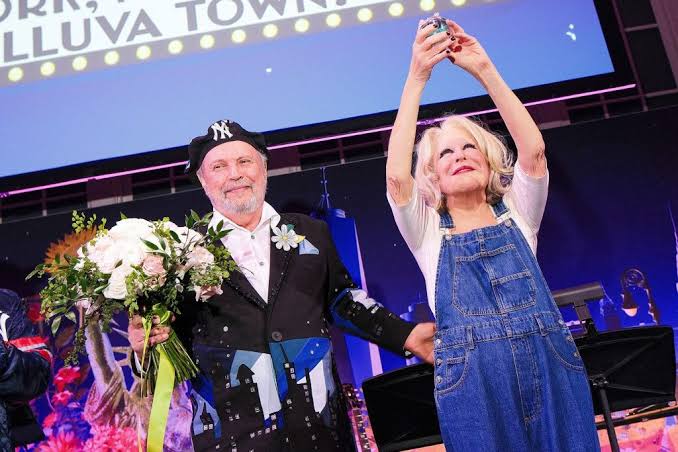
Bette Midler accepted the 2026 Woody Guthrie Prize on Friday, October 16, at Cain’s Ballroom in Tulsa, Oklahoma, marking a new milestone in her decades-long career as a singer, actress and activist. During the ceremony, Midler performed a rewritten version of Woody Guthrie’s protest song “All You Fascists (Bound to Lose),” describing the updated recording as her “small contribution to the Resistance.”
The award, presented annually by the Woody Guthrie Center, recognises artists whose work reflects Guthrie’s legacy of using music and other creative forms to address social issues and advocate for people facing injustice. Midler was selected for the honour in recognition of her entertainment career and her longstanding support for environmental conservation, LGBTQ+ rights, public health initiatives and humanitarian causes.
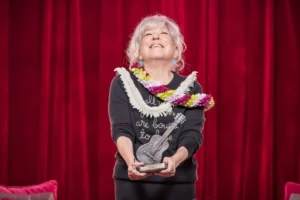
Midler’s acceptance included a conversation with music journalist Rona Elliot, during which she discussed the relationship between artistic expression and activism. She also spoke about Guthrie’s legacy and the continued relevance of his protest music. The evening included remarks from members of Guthrie’s family and a performance by country singer Bryan Andrews.
Midler’s performance centred on “All You Fascists (Bound to Lose),” Guthrie’s protest song from the 1940s. She released her updated version in April 2026, rewriting portions of the lyrics to address contemporary political concerns. The recording and accompanying video featured appearances by several entertainers, including Barbara Hershey and David Hyde Pierce.
At the ceremony, Midler explained why she had chosen to adapt the song. “Justice doesn’t always come from the courthouse,” she said. “Sometimes the law is late, overdressed, and on the wrong side. Justice comes from a beat-up guitar instead.” She added that she had taken Guthrie’s song and given it new words because, in her view, longstanding political struggles had returned in different forms.
“Thank you for accepting me, and for letting me rewrite the song, that became my small contribution to the Resistance,” Midler said. She described the current period as difficult and characterised the song as a way of responding to the political climate through music. During the performance, she wore a T-shirt displaying the song’s title.
Midler’s updated recording has become part of her recent public commentary on American politics. When she released the video in April, she encouraged listeners to sing the song at demonstrations, saying that music could be a way to express opposition and bring people together. Her adaptation was co-written with Eric Kornfeld, while Midler served as executive producer of the video, directed by Toni Basil and Seanne Farmer.
Members of Guthrie’s family praised Midler’s work at the event. Anna Canoni, Guthrie’s granddaughter, said Midler’s version had brought the folk singer’s music back into contemporary protests and conversations about democracy and humanity. She described Midler as an artist who had carried Guthrie’s words into a new generation of public debate.
Cady Shaw, senior director of the Woody Guthrie Center, also recognised Midler’s contribution. Shaw said the prize celebrates artists whose influence extends beyond their creative achievements and who use their platforms to support meaningful change. She described Midler as someone who understands the responsibility artists can have toward their communities.
The evening also served as a fundraiser for the Woody Guthrie Center, supporting its educational programmes, exhibitions, public events and outreach. A silent auction featured items from Midler’s personal collection and archive, a signed lithograph by Bob Dylan, rare prints and other experiences. Bryan Andrews performed original songs and led the audience in a sing-along of Guthrie’s “This Land Is Your Land.”
Established in 2014, the Woody Guthrie Prize has recognised artists including Pete Seeger, Mavis Staples, Kris Kristofferson, John Mellencamp, Norman Lear, Chuck D, Joan Baez, Bruce Springsteen, Tom Morello, Pussy Riot and U2. The award highlights the role of music, film, literature and other art forms in advancing social change, following Guthrie’s belief that creative work could speak for people whose voices were often overlooked.
Midler, 80, has received numerous awards throughout her career, including three Grammy Awards, three Primetime Emmy Awards and a Tony Award. Her work has extended across music, film and theatre, alongside decades of advocacy and fundraising. Her selection for the Woody Guthrie Prize recognises that combination of artistic achievement and public engagement.
The October 16 ceremony brought Midler’s adaptation of Guthrie’s protest song to the centre of the evening, connecting the folk singer’s historical catalogue with current political concerns. Her acceptance and performance also continued the Woody Guthrie Center’s tradition of honouring artists who use their work to address social justice and public life.